
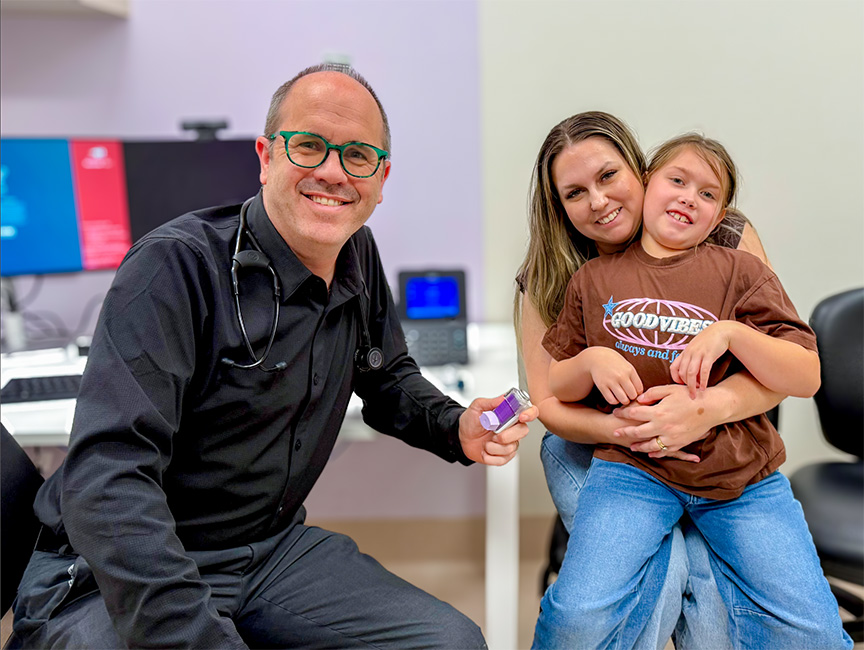
The Queensland Children’s Hospital is the first in Australia to embed smart inhaler technology into standard clinical care, helping children with complex asthma and their families better manage the condition and reduce unplanned hospital visits.
Around 15,000 Australian children aged 14 and under are hospitalised with asthma each year, making it the leading cause of disease burden among children in this age group.
Now, a small electronic sensor attached around a child’s regular asthma inhaler is giving clinicians better insights into medication use, helping to identify barriers to effective treatment and management, before they lead to an asthma attack or hospital visit.
The sensor, created by Adherium, automatically records the date and time an inhaler is used, along with information about inhalation technique.
Queensland Children’s Hospital Senior Medical Officer Professor Paul Robinson said the technology was changing the way clinicians could understand and support children with complex asthma.
“Asthma can be incredibly complex, and it’s not always easy to understand why a child continues to struggle with symptoms or have recurring asthma attacks,” Prof Robinson said.
“This technology gives us a clearer picture of what is happening day to day, which we can share with families to identify barriers to care and provide more personalised support.
“For example, a missed dose could be due to a busy family routine, a practical barrier or a misunderstanding about when medication should be taken.
“Having this information allows us to have more meaningful conversations with families and tailor our support to what that individual child needs,” he said.
The technology can also help clinicians determine when asthma remains poorly controlled despite medication being taken correctly, prompting a review of whether a child’s treatment needs to be adjusted.
The Queensland Children’s Hospital’s complex asthma service has seen more than 50 children since launching in 2024. Since then, patients using the new smart inhaler technology have recorded fewer asthma-related hospitalisations.
The complex asthma team aims to expand the use of this technology beyond children with complex asthma, helping more Queensland children and families better manage their condition and reduce preventable hospital visits.
ENDS