
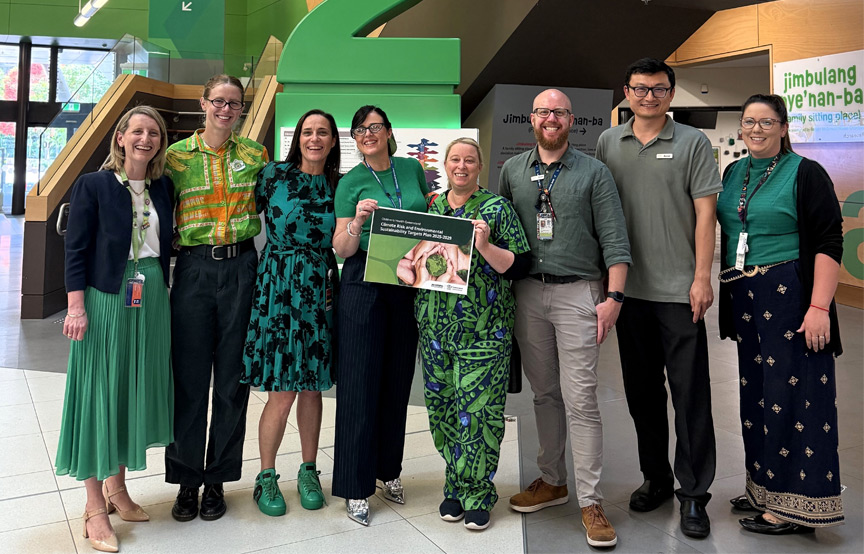
Children’s Health Queensland today launched its Climate Risk and Environmental Sustainability Targets (CREST) Plan 2025–2029 setting a clear path towards a healthier, resilient planet for current and future generations to thrive in.
The CREST plan outlines an ambitious roadmap to deliver ‘high-value, low carbon’ healthcare that reduces emissions, minimises waste, strengthens climate resilience and embeds sustainable healthcare practices across the organisation.
Developed in collaboration with staff, patients and families, partners and sustainability experts, it focuses on six key areas: sustainable infrastructure, ethical procurement, low-emission transport, clean energy and water use, waste reduction, and climate leadership and resilience.
The plan builds on Children’s Health Queensland’s long-standing commitment to embedding sustainable thinking and action into its systems, services and infrastructure.
Since launching its first sustainability plan in 2021, Children’s Health Queensland has made significant progress towards its ‘green’ goals, including diverting nearly 500 tonnes of waste from landfill through 42 active recycling streams and reducing paper use by 44 per cent.
The Queensland Children’s Hospital also became the first in the state to complete the Global Green Health Hospitals Climate Impact Checkup Tool and report on its hospital-level carbon emissions.
Children’s Health Queensland Chief Executive Frank Tracey said the organisation took seriously its obligation to protect the health and wellbeing of children, as well as the planet they rely on.
“Children are uniquely vulnerable to the impacts of climate change, and as a paediatric health service, we have both a responsibility and an opportunity to lead the way,” Mr Tracey said.
“This plan is about reimagining the way healthcare is delivered in Queensland to support healthier futures for children and young people. It’s our promise to take action today to help create a healthier, sustainable tomorrow.
“I would like to acknowledge and thank our dedicated workforce who champions this culture of sustainability and share our vision of providing environmentally responsibly and future-focused care.
“Sustainability is now woven into who we are — how we care, how we build, and the legacy we leave behind,” Mr Tracey said.
Read our Climate Risk and Environmental Sustainability Targets (CREST) Plan 2025–2029.