
Your child grows faster in their first five years than at any other time. Staying up to date with health and development checks can help spot concerns early and give your child the best start in life.
The first five years of a child’s life are an important time for physical growth and development. In these early years, their brain and body are growing faster than at any other time, shaping the way they think, learn, communicate, move and play. Free health and developmental checks, available through community child health nurses, local health clinics, or GPs, can help track if a child is healthy and following typical growth and development patterns and reaching important developmental milestones.
Why are child health checks so important?
”Regular health and development checks from birth to school age are the best way to know if your child is growing, learning and developing as expected,“ explains Cathy Marron, Nursing Director of Children’s Health Queensland’s Child Health Service.
“The checks help you understand your child’s growth and development, and can identify potential problems early, so they receive the right support at the right time, which can often make a big difference to their long-term health and wellbeing outcomes."
“It’s important to check your child, even if they appear to be healthy and well,” Cathy warns. “It’s about identifying problems early and ensuring a child gets the support and treatment they need to help them reach their full potential.
“Life gets busy, especially as children start childcare, kindy and other activities. But keeping up with regular health checks is one of the simplest ways to support your child’s health and development and ensure they’re ready to thrive at every stage of childhood.”
Regular health and development checks are also an opportunity for babies and children to have their routine vaccinations. These vaccines are free under the National Immunisation Program.
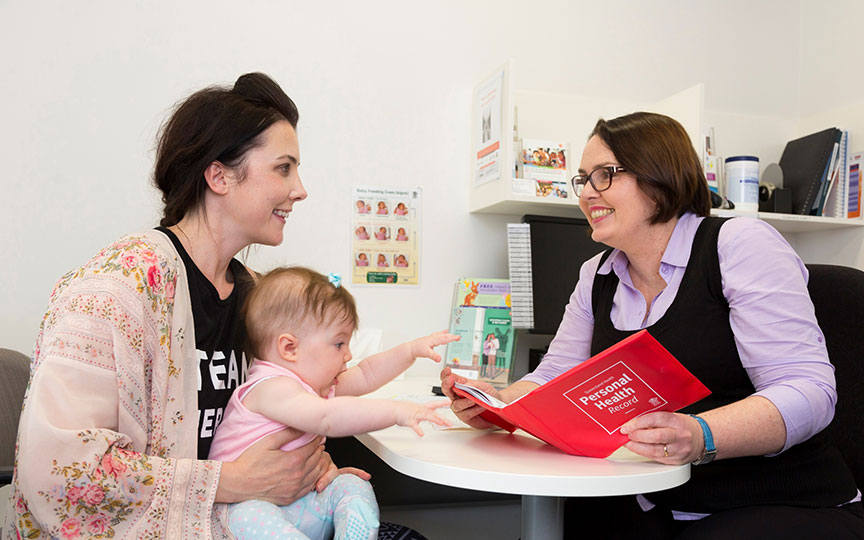
In Queensland, your child's Personal Health Record, commonly known as the ‘Red Book’, helps you keep track of key age health checks, immunisations and developmental milestones.
Bring the Red Book to every appointment so your child health nurse or doctor can record your child's progress and discuss any concerns.
What happens at each age check?
After your child’s newborn, two-month and four-month health assessments, regular health checks continue throughout the early years. They give health professionals a chance to check things like:
- growth and physical health
- hearing and vision
- communication and language skills
- movement and motor skills
- social and emotional development.
6 months
At six months, the health check focuses on your baby’s growth and development.
Your doctor or child health nurse will check:
- weight and length
- head growth
- hearing and vision
- movement and mobility
- ears, eyes and hips
- overall physical health
Your baby will also receive their six-month vaccinations.
Aboriginal and/or Torres Strait Islander babies will usually have a healthy hearing check at this age.
12 months
At 12 months, your child’s health professional will look at their growth, development and wellbeing.
The check may include:
- growth and development
- hearing and vision
- communication skills
- nutrition
- behaviour and relationships
- family wellbeing
This is also a good time to ask questions about:
- sun safety
- play and learning
- bonding and attachment
- oral health
Your child will also be due for their 12-month vaccinations.
18 months
By 18 months, children are becoming more active and independent.
Health checks at this age look at:
- growth and development
- hearing and vision
- communication and language
- walking and movement
- fine motor skills like picking up small objects
- gross motor skills like running and climbing
You can also talk with your doctor or child health nurse about:
- language and speech
- healthy eating
- toilet training
- injury prevention
- sibling relationships
- parent-child relationships
Your child will also receive their 18-month vaccinations.
2 ½ to 3 ½ years
During these years, health checks continue to track your child’s growth and development.
Your doctor or child health nurse may check:
- hearing and vision
- speech and language
- movement and coordination
- heart health
- growth and nutrition
- general physical health
You may also want to talk about screen time, sleep routines, behaviour, toilet training, injuries during play and how your child interacts with others. These conversations can help find any areas where your child may need extra support.
4 to 5 years
The health check before your child starts school is especially important.
Your doctor or child health nurse will check:
- growth
- hearing
- vision
- speech and language
- overall development
Finding concerns before school starts can help children get support early. For example, hearing or vision problems may affect learning if they aren’t found and treated early.
Parents’ Evaluation of Development Status
At each health check, parents and carers are asked to complete the Parents’ Evaluation of Developmental Status-Revised® (PEDS-R®) questionnaire in the Red Book.
The questionnaire asks questions about your child’s development and behaviour. It helps find any concerns early so children can get the support and services they may need.
Finding concerns early can make a big difference to a child’s health, learning and development.
Is your child reaching the typical developmental milestones?
Health checks are also a great time to talk about your child’s developmental milestones.
Parents can use the Milestones Checklists for Child Development (birth to 18 months and 2 to 5 years) to learn what skills children commonly develop at different ages and to keep track of and celebrate their child's progress.
If you have any concerns, the checklists can help you start a conversation with your child health nurse or doctor.